Herndon, VA · Garage Door Service
What Actually Happens When We Come Out to Your Door
A clear look at what a Herndon garage door service call checks, given 1980s-90s housing stock and cold-climate hardware wear common in this area.
- Repairs & new doors
- Springs & openers
- Serving 4 nearby communities
What Most People Get Wrong
Most calls start with someone telling us the opener is broken. Half the time the opener is fine. The housing stock around here runs from 1938 up through 2015, with the median build year sitting around 1981, which means a lot of doors are original or close to it, running on hardware nobody has serviced since the Reagan administration. People assume a dead opener means a new opener. What it usually means is a spring that's lost tension and is making the opener do work it was never built to do - and burning itself out doing it.
The other thing people get wrong is thinking a service call is just a quote visit. It isn't. We check the door, not just the symptom you called about. A door built in the 1980s or 90s, which describes most of what's out there across this area, has rollers, hinges, and a torsion spring system that all age together. If you only fix what's loud, you're back in six months for the part that was quietly failing next to it.
The Situation
Across the areas we work - Great Falls, Wolf Trap, Dunn Loring, Merrifield, Falls Church, and the rest out toward Franconia and Rose Hill - the housing stock is mostly 1980s and 90s construction. That's not a small detail. Doors from that era were built to specs that have since changed, and parts for them are a mixed bag: some are still common stock, some you have to special-order and wait on.
With 49,510 owner-occupied houses across the service area, most of what we see on a given week is the same handful of failure points repeating: torsion springs that have cycled past their rated life, nylon rollers that have gone brittle, and openers original to the house straining against springs that no longer carry their share of the door's weight. A service call on a house this age usually means checking all three, because by the time one fails, the other two aren't far behind.
When to Call Someone
Call before the door won't open at all, not after. A spring that's starting to sag shows itself first as a door that feels heavier when you lift it by hand, or an opener that strains and groans on the way up. That's the window where a repair is cheap. Wait past it and the cable can jump the drum or the spring can snap outright, and now you've got a door that's stuck closed with a car trapped behind it or stuck open with your house exposed.
We'll be straight with you: not every door is worth repairing. If the door is original to a house built in the early part of that 1938-to-2015 range and the track is bent along with a dead spring, replacement is usually the better money than chasing parts for a door that's going to need something else in a year. We'll tell you which situation you're in before we start charging for parts.
How Local Conditions Play In
This area sits in a severe cold climate band, and that matters for a garage door in ways people don't think about until it's -10°F and the door won't budge. Cold makes torsion springs stiffer and more prone to snapping if they were already fatigued, because metal that's lost some flex handles sudden cold load worse than metal that's fresh. It also shrinks door panels and seals just enough that weatherstripping which was fine in August leaves a gap in January.
On a service call in winter, we're checking balance and spring tension with that cold-weather stress in mind, not just whether the door goes up and down in a heated garage on a mild afternoon. A door that operates fine at 50°F and binds at 15°F isn't an opener problem - it's a hardware problem the cold is exposing. That's part of why we look at the whole system on every visit instead of just the part you called about.
Frequently asked questions
How do I know if it's the spring or the opener?
If the door feels heavy when you lift it manually with the opener disconnected, it's the spring. If the opener hums or clicks but the door doesn't move at all even with help lifting, it's more likely the opener or the drive gear. We check both on every call since one often masks the other.
Is my door too old to repair?
Depends on the door, not just the age. A lot of houses in this area date to the 1980s and 90s, and plenty of those doors still take standard-size torsion springs and rollers. If the track is bent or the panels are rusted through, replacement usually makes more sense than repeated repairs.
Why does my door act up more in winter?
Cold stiffens torsion springs and shrinks weatherstripping. A spring that's already near the end of its cycle life is far more likely to snap in a hard cold spell than during a mild stretch, which is why winter service calls often turn up fatigue that's been building for months.
What's included in a standard service call?
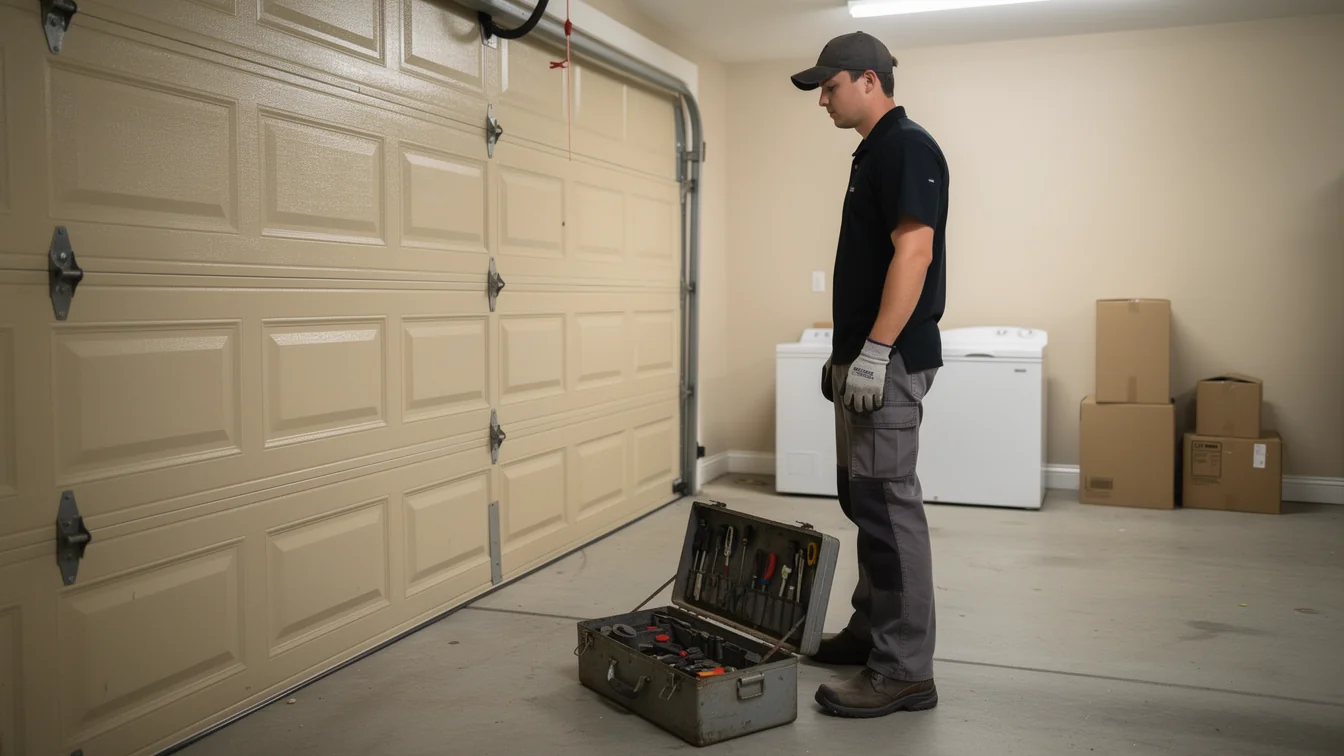
We check the spring tension and balance, the rollers and hinges, the track alignment, the cables, and the opener's force settings - not just whatever symptom prompted the call. On older doors that's usually where the real problem is hiding.
Related garage door services in Herndon
More garage door guides
Book garage door service in Herndon
Call now or request a quote - tell us what the door is doing and where you are.