Herndon, VA · Garage Door Service
What Cold Weather Does to Herndon's Older Garage Door Springs
Herndon's housing stock, mostly built 1938-2015, means older torsion springs failing in cold snaps. Here's what to check before you call for repair today.
- Repairs & new doors
- Springs & openers
- Serving 4 nearby communities
What Most People Get Wrong
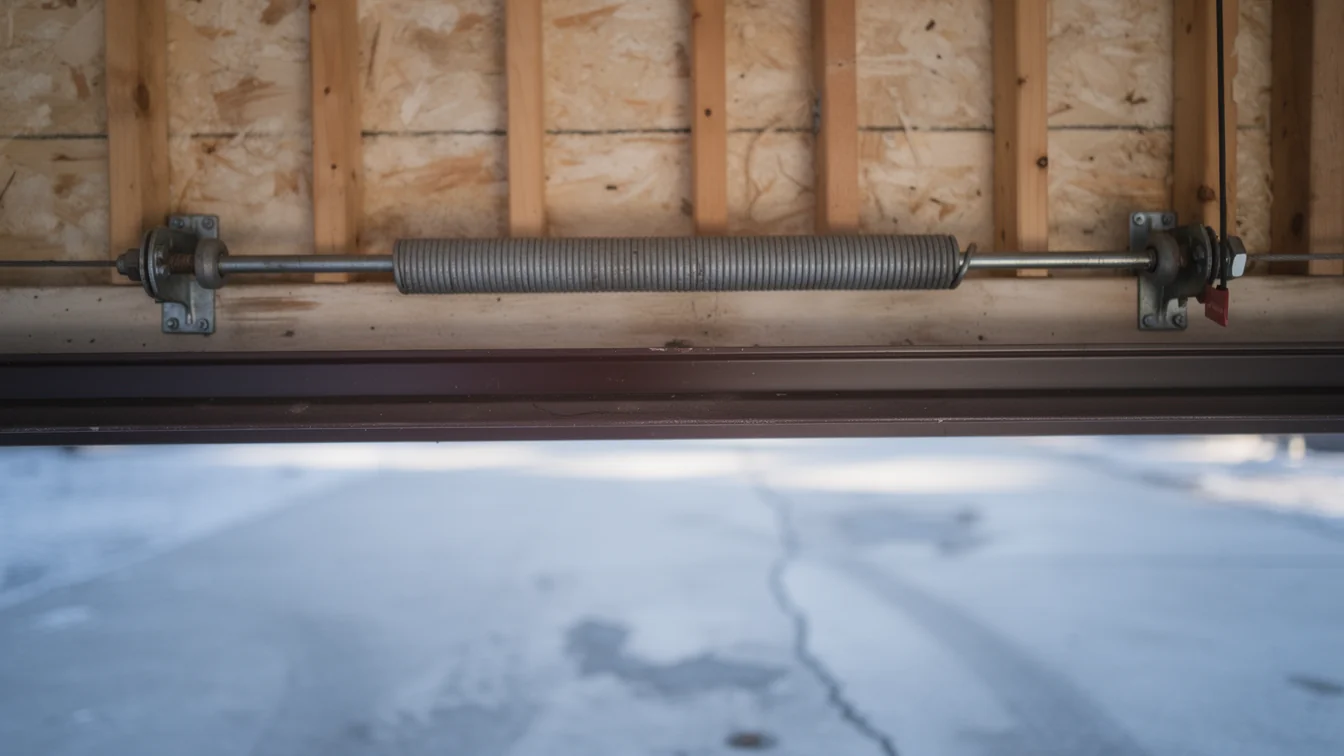
Most homeowners treat a stuck or noisy garage door as a random glitch, something that will sort itself out after a squirt of oil. In Herndon that assumption costs money. Housing here spans 1938 through 2015, with the bulk of the stock dating to the 1980s and 90s. That means a lot of torsion springs on the road are thirty-plus years old, rated for a cycle count they've already exceeded. A spring doesn't fail because of one cold morning. It fails because years of use have already thinned the metal, and cold weather is just the final push that snaps it. People hear the bang and blame the temperature. The temperature didn't do it alone - the age of the hardware did most of the work. Another common mistake: spraying WD-40 on a spring and calling it lubricated. WD-40 is a degreaser, not a lubricant, and it strips what little coating is left on an older coil. If your door was installed anywhere near the median build year for this area, the spring inside it was likely sized and wound for a lighter, newer panel than whatever's hanging on it now after years of adjustments and replacements.
The Situation
Herndon sits in a climate zone rated cold and severe, which matters more for garage hardware than people expect. Steel contracts as temperatures drop, and a torsion spring under load behaves differently at 15°F than it does at 70°F. The coil gets stiffer, more brittle, less willing to flex through its last few winds before it lets go. Combine that with housing stock that runs mostly 1980s and 90s vintage, and you get a specific, local failure pattern: original or first-replacement springs, often undersized for later heavier insulated doors, reaching end-of-life right as the first hard freeze hits. This isn't a theory about garage doors in general - it's what thirty-year-old galvanized coil does in this climate band. Owners in newer construction, built toward the 2015 end of that range, see fewer of these early-winter failures simply because the hardware hasn't had as many cycles yet. The pattern tracks the age of the house, not the brand of the door.
When to Call Someone
Don't wait for a complete failure. If the door is noticeably harder to lift by hand, if you hear a loud pop followed by the door refusing to move, or if you see a visible gap in the coil when the door is down, that's a spring that has already gone or is about to. Torsion springs are under heavy tension and not a safe DIY repair - that's not a sales line, it's a real hazard with any spring, in any town. What's specific to Herndon is timing: cold-snap failures cluster in winter here because of the age profile of the local housing stock, so a spring that's been making noise since fall is worth replacing before the first deep freeze, not after. One honest limitation: if your door and opener are both original to a house built decades ago, a spring swap alone sometimes isn't the fix - worn rollers, a stretched cable, or an opener that can't handle a heavier replacement panel may need attention at the same time, and parts for some older models take longer to source.
How Local Conditions Play In
Herndon's service area includes a wide mix of owner-occupied houses - the broader area counts roughly 49,510 of them among 131,069 households - and most of that housing dates to the 1980s and 90s build wave, with the full range running 1938 to 2015. That spread matters because spring wear isn't uniform: a 1985 build and a 2012 build in the same cold-severe climate zone are at very different points in hardware life expectancy. Median household income in the area, over $153,000, also shows up in the kind of doors we see - more double-wide insulated panels on two-car attached garages than lightweight single doors, which puts more load on the spring system to begin with. Out toward Great Falls, Wolf Trap, and Dunn Loring, the same cold band and similar-era construction mean the same winter pattern repeats. It's not a Herndon quirk so much as a regional one, but it's real and it's measurable in the age of the hardware on these streets, not just the thermometer.
Frequently asked questions
Why did my spring break overnight with no warning?
It rarely happens with no warning - there's usually noise or stiffness beforehand that gets missed. What feels sudden is often a spring that's been weakening for years, reaching the end of its cycle life right as cold weather makes the metal more brittle. The cold is the trigger, not the root cause.
Is my garage door old enough that the spring is a risk?
If your house was built anywhere in the 1980s or 90s, which covers most of this area, the odds are higher that the spring has been through enough cycles to be near end of life, especially if it's never been replaced. Age of the house is a reasonable starting guide, though not a guarantee.
Can I just replace the spring myself?
A torsion spring holds enough stored tension to cause serious injury if it's wound or unwound without the right bars and technique. This isn't specific to older hardware - it's true of any torsion spring. We'd rather you call than attempt it with the wrong tools.
Related garage door services in Herndon
More garage door guides
Book garage door service in Herndon
Call now or request a quote - tell us what the door is doing and where you are.