
Herndon, VA · Garage Door Service
Fixing vs. Replacing: What Herndon's Older Garage Doors Can Handle
Most garage doors in Herndon date to the 1980s and still run original torsion hardware. Here's how to tell what's worth fixing before winter hits hard.
- Repairs & new doors
- Springs & openers
- Serving 4 nearby communities
What Most People Get Wrong
The first assumption most homeowners make is that a noisy or slow door means it's time to replace the whole unit. That's usually wrong. Herndon's housing stock runs from 1938 up through 2015, with the median build year sitting at 1981, and a door from that era isn't automatically junk. The track, the panels, and the opener are three separate systems with three separate lifespans. A torsion spring failing on a 1981 door doesn't mean the door itself has failed - it means a $200-300 part reached the end of its cycle count, which for a standard spring is somewhere around 10,000 open-close cycles.
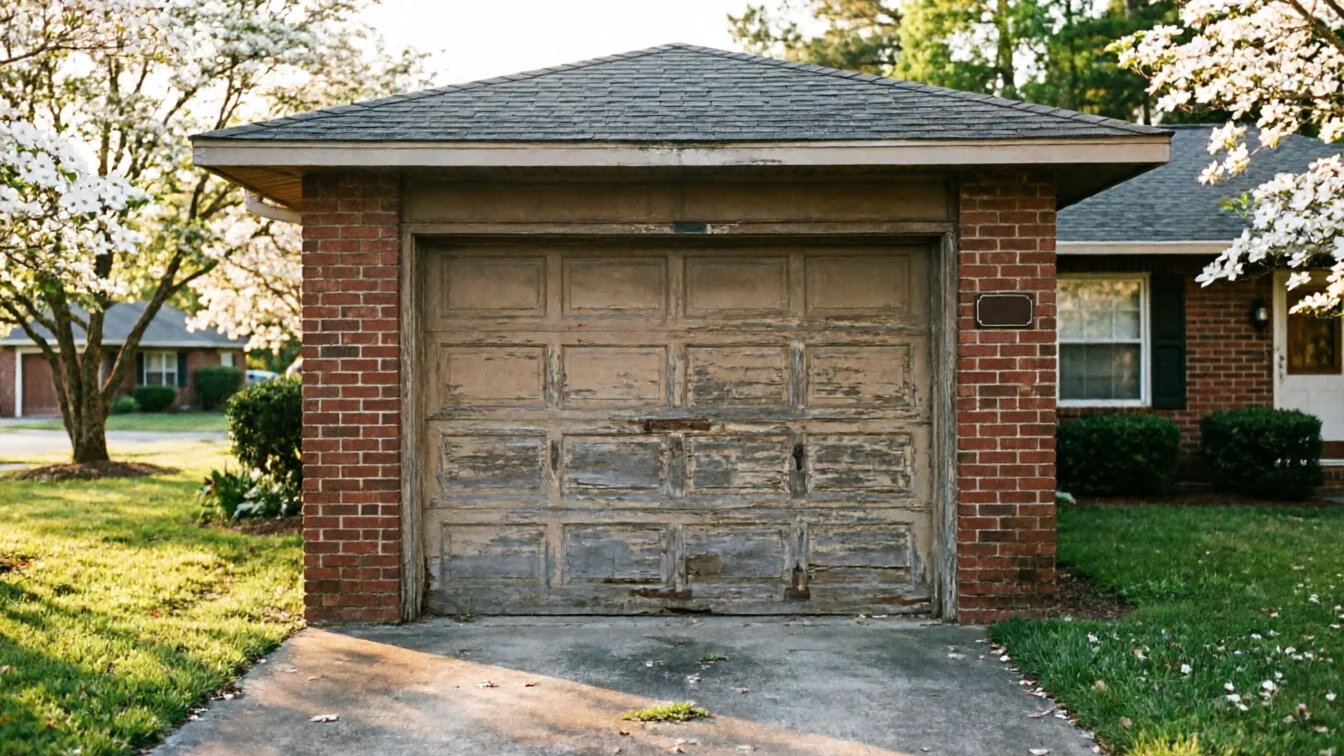
The opposite mistake happens too: people keep throwing WD-40 and patch repairs at a door that's actually done. If the track is bent in more than one place, if the bottom panel has rotted or rusted through, or if the door is wood instead of steel, you're not fixing your way out of that. The honest answer sits in between, and it depends on which part failed, not on how old the door looks from the driveway. We look at the hardware generation first, then decide.
The Situation
Most of the doors we get called on here are original equipment from the 1980s and 90s building boom, the same era across the thirty or so neighborhoods in this part of the corridor. That matters because hardware standards shifted more than once since then - torsion spring winding methods, cable gauge, and track profiles from a 1985 install aren't always a drop-in match for parts sold today. Some of it is still stocked. Some of it isn't, and that's the honest limitation: if your door uses a discontinued drum or an obsolete track width, a repair can turn into a full replacement simply because the part doesn't exist anymore, not because the door failed.
Houses built in the 1938-2015 range, with that 1981 median, mean we see a wide spread of hardware generations on any given street - galvanized torsion springs next to older extension-spring setups, steel panels next to a handful of older wood doors. There's no single answer for 'this neighborhood's doors,' which is exactly why a quick look at the actual hardware matters more than the house's build year by itself.
When to Call Someone
Call before the door fails completely, not after. A spring that's visibly stretched, a gap you can see daylight through at the coil, or a door that slams down instead of lowering smoothly are all signs the torsion spring is close to snapping - and a snapped spring under tension is a real injury risk, not just an inconvenience.
Other signs worth a call rather than a wait: cables that have started to fray near the bottom bracket, a track that's pulled away from the wall on one side, rollers that have gone from quiet rolling to grinding, or an opener that runs but doesn't fully seat the door at the bottom. Any of those point to a specific, fixable part. What doesn't get a repair call is rust-through on the bottom panel section or a door that's racked out of square in its frame - at that point you're paying labor twice, once to patch and once to replace within a year or two. If you're not sure which category you're in, describe what you're seeing and hearing rather than guessing at the diagnosis yourself.
How Local Conditions Play In
Herndon sits in a cold-severe climate band, which means torsion springs here see more expansion and contraction cycles each year than a door in a milder zone would. Steel coils tighten slightly in cold temperatures and loosen as they warm, and that daily swing adds up over decades faster than most people expect. A spring rated for a certain cycle count in a mild climate wears through that count sooner here.
A 1981-built door in Herndon is now on its third or fourth decade of service, well past the point most torsion springs were designed to last, and cold-weather cycling is part of why. Lubricant also behaves differently in winter - grease that's fine in August can stiffen enough in January to make an opener strain against a track it would otherwise handle easily, which shows up as a door that struggles only on the coldest mornings. Between the age of the original hardware and the winters here, a lot of Herndon garage doors are carrying springs that have already outlived their rated cycle count without anyone noticing, right up until one lets go.
Frequently asked questions
My door is from the 1980s. Is it worth fixing or should I just replace it?
Depends on what broke. If it's a spring, cable, or roller, those are standard wear parts and repair almost always makes sense on a door that's otherwise sound. If the track is bent in multiple spots or the panels have rusted through, you're usually better off replacing rather than patching a door that's failing structurally.
Why did my spring break in winter and not summer?
Herndon's cold winters put more expansion and contraction stress on torsion springs than warmer months do, and that cycling adds up faster on an older spring that's already near the end of its rated life. Winter just tends to be when a spring that was already close to done finally lets go.
Can you still get parts for a door built in the 1980s?
Sometimes, sometimes not. Standard torsion springs and cables are easy. Original drums, certain track widths, and some older extension-spring hardware have been discontinued over the years, and if your door uses one of those, repair can turn into a replacement simply because the part isn't made anymore.
Related garage door services in Herndon
More garage door guides
Book garage door service in Herndon
Call now or request a quote - tell us what the door is doing and where you are.